Most conversations about a corrugated countertop display start with the artwork and the shape. The question that actually decides whether the unit survives its life on a busy counter is quieter: what is the board made of, and how much can it hold. A display that looks perfect in a rendering but sags under a dozen jars is a failure, and so is one that is overbuilt in heavy board for a few lightweight sachets. This is a plain-language explainer of the two specs that govern that outcome, flute profile and edge crush, and how to read them when you order.
Flute profile is the board’s inner architecture
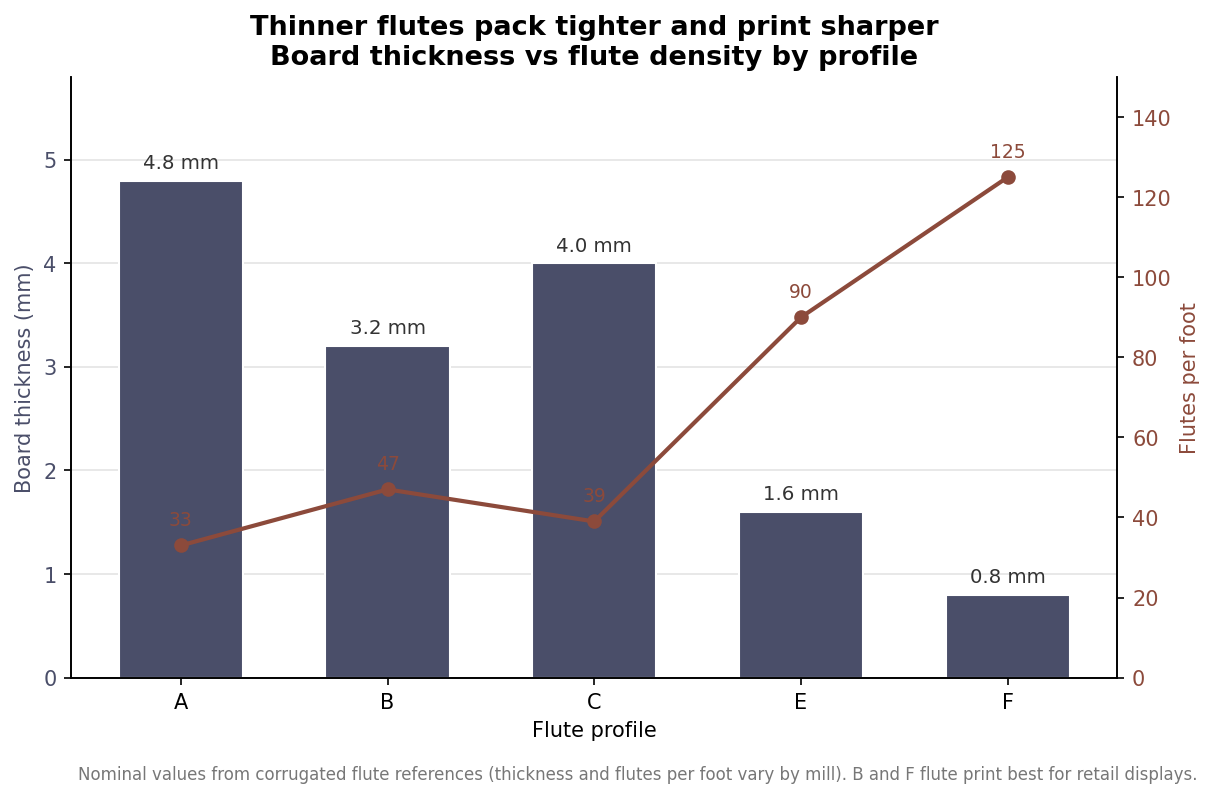
Corrugated board is a fluted inner layer glued between flat liners, and the size of that flute changes almost everything about how the board behaves. Profiles are named by letter, and they run from thick and coarse to thin and fine. A flute is the thickest common profile at about 4.8 mm with roughly 33 flutes per foot, built for heavy or fragile shipping. C flute sits near 4.0 mm and about 39 flutes per foot as a general shipping board. B flute, around 3.2 mm and 47 flutes per foot, is a workhorse for retail displays and die-cut boxes because it combines solid crush resistance with a flat, printable face.
The thin profiles are where fine graphics live. E flute, at roughly 1.6 mm and about 90 flutes per foot, is a lightweight retail-ready board, and F flute, near 0.8 mm and 125 flutes per foot, is the premium packaging profile that holds the sharpest print. The pattern is consistent: more flutes per foot means a thinner board with a smoother surface that accepts ink more crisply, while fewer, taller flutes trade print fidelity for cushioning and stacking strength. For a printed countertop display, B flute and F flute are the usual recommendations, with B carrying more structural load and F reserved for high-resolution, lighter-duty pieces.
Edge crush is the number behind the load
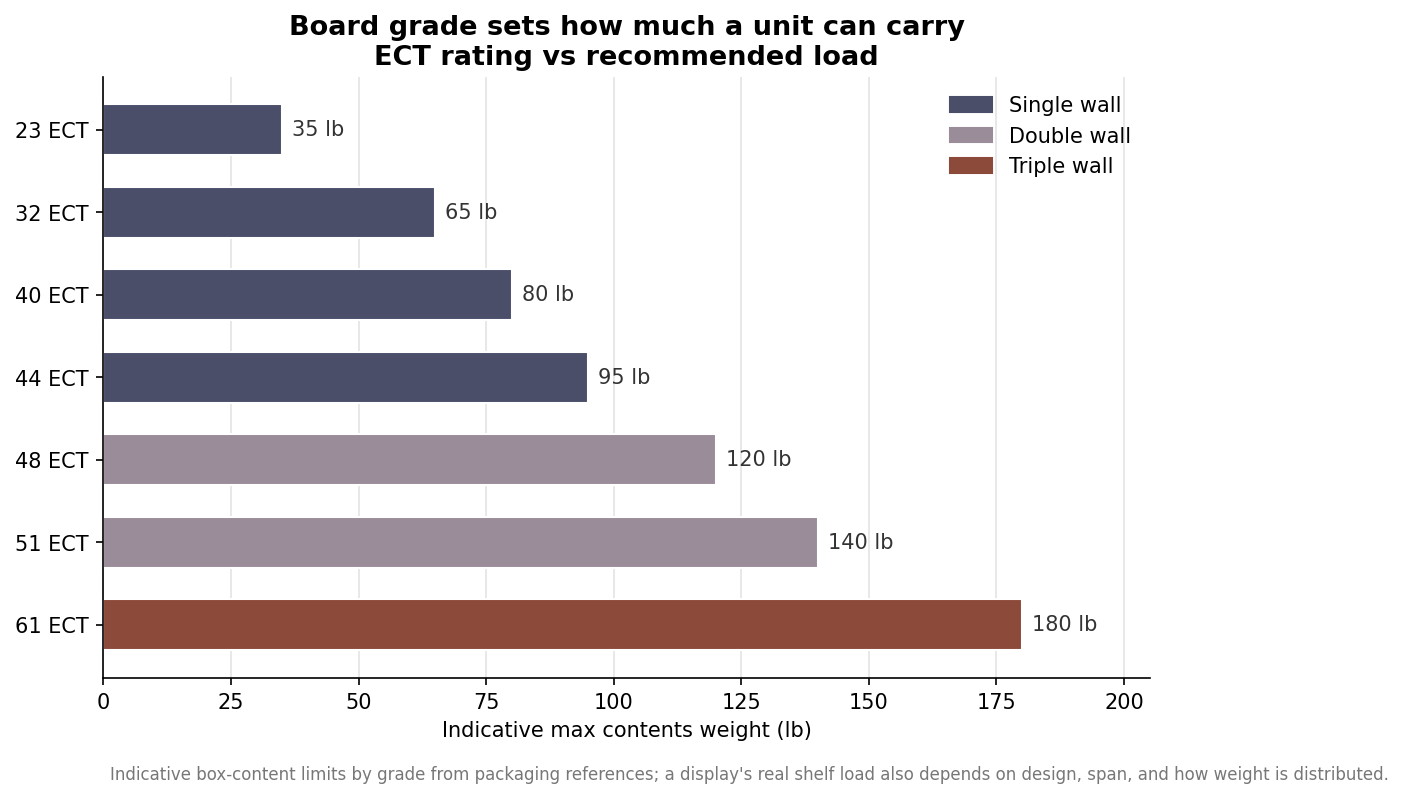
Where flute describes the architecture, the Edge Crush Test, or ECT, measures how much force the board’s edge can bear before it buckles, reported as pounds per inch. ECT is the practical strength number, because vertical compression is what actually fails a display or a stacked box. As a rough map from packaging references, a 23 ECT single-wall board suits contents up to about 35 pounds, 32 ECT up to about 65 pounds, 40 ECT near 80 pounds, and 44 ECT up to roughly 95 pounds. Move into double wall and the numbers climb, with 48 ECT around 120 pounds and 51 ECT near 140 pounds, while triple-wall 61 ECT reaches about 180 pounds.
Two honest caveats belong on those figures. They describe recommended contents weight for boxes under normal handling, not a guaranteed shelf rating for a specific display design, and real-world capacity drops with humidity, long storage under load, and rough transit. A display’s usable load also depends heavily on its own geometry, which the ECT number cannot capture on its own.
Why a display is not just a strong box
A box gets its strength from four closed walls bearing load together. A countertop display gives some of that up on purpose, cutting away faces for visibility and access, which means the board grade alone does not tell you what a shelf will hold. Span is the hidden variable. A wide, unsupported shelf in the same board as a narrow one will bow far sooner, because the load sits farther from the supporting walls. Good display engineering puts that strength back with design rather than only with heavier board: return flanges on shelf edges, tabbed supports that transfer weight down to the base, and dividers that turn one long span into several short, stiff ones.
This is why two displays of identical footprint can hold very different weights. A well-designed unit in 32 ECT B flute with proper shelf returns can outperform a poorly designed one in heavier board, and it does so while shipping flat and setting up faster. When you brief a supplier, describe the product’s weight and how many facings each shelf must hold, not just the board grade, so the structure can be designed around the real load.
Reading a spec and asking the right questions
Put the pieces together and a sensible countertop display spec reads as a short set of linked choices. Name the heaviest product the unit will hold and the number of units per shelf, so the designer can target an ECT and a shelf structure. Choose the flute for the print you need, leaning to B flute when a shelf carries real weight and to E or F flute when graphics are the priority and the load is light. State whether the piece ships assembled or flat, since flat-packed die-cut displays in B or E flute travel cheaper and set up on the counter in seconds.
Then ask two questions that separate a reliable supplier from a hopeful one. First, ask for the board grade and flute in writing, not just a promise that it is strong, so you can compare quotes on equal terms. Second, ask for a physical sample loaded with your actual product before committing to a full run, because a display that holds its contents on a warehouse floor in dry air is the only proof that matters. Corrugated is inexpensive per unit at volume, but a display that collapses on a retailer’s counter costs far more than the board ever saved. Specifying flute and ECT deliberately, and pairing them with sound structural design, is what turns a good-looking display into one that still looks good on day ninety.
Leave a Reply