Most buyers start a countertop display project by arguing about material, but the format decides more than the material ever will. A tray, a dump bin, a clip strip and a tiered riser can all be printed on the same corrugated board and still perform completely differently at the register. The right format follows from three things: the shape and weight of what you are selling, how a clerk will restock it, and how much counter real estate a retailer will actually give you. Getting that match right is what separates a display that clears through and gets reordered from one that ends up flattened behind the counter.
The tray and PDQ family: fast to stock, easy to say yes to
Trays are the workhorse of the counter. A PDQ tray (the initials stand for “pretty darn quick”) is a shallow open box that arrives pre-filled, so a store associate drops the whole unit on the counter without touching individual items. That single quality is why buyers, category managers and store staff tend to approve them: restocking is measured in seconds, not minutes. Trays suit small, uniform, boxed or pouched products that stand or lie neatly in rows, which is why you see them holding lip balm, energy shots, trading cards and single-serve snacks. Because the walls are low and the footprint is compact, a tray asks a retailer for very little space, and a small ask is an easy ask. The trade-off is capacity and drama. A tray holds a modest facing count and does little to build height or theater, so it wins on convenience rather than on stopping power.
Dump bins and impulse bins: volume over precision
Dump bins trade neatness for sheer quantity. A counter dump bin is a deeper open container meant to hold loose or bagged product that customers rummage through, which makes it ideal for candy, seasonal novelties, clearance items and anything cheap enough to buy on impulse without inspection. The message a bin sends is “grab one,” and that informality is the point. Where a tray presents products in tidy rows, a bin invites hands in. The design cost is structural: a bin that carries several kilograms of loose weight needs stronger board and often a reinforced base, so it leans toward heavier flute grades than a light tray would. Bins also read as promotional rather than premium, so they fit value and seasonal plays far better than they fit a considered, higher-ticket product.
Clip strips, sidekicks and hanging counter units
When the counter is full, go vertical or borrow someone else’s fixture. Clip strips hang packaged product from an existing shelf edge or endcap upright, turning dead vertical space into facings without asking for any counter footprint at all. They are the cheapest way to gain placement, but they only work with hang-ready packaging that has a hang hole or header. Sidekick displays do something similar at scale, mounting to the side of a gondola so a secondary product rides alongside a primary category. For a counter specifically, a small hook or pegboard unit performs the same trick in miniature, presenting blister-packed or header-carded items upright where a flat tray would waste the vertical room. These formats reward products that are already designed to hang; they punish anything that needs to sit flat or stack.
Tiered risers and literature holders: height and information
Tiered units solve visibility; literature holders solve explanation. A stepped riser lifts back rows so every product is visible from a standing customer’s eye line, which matters when facings would otherwise disappear behind the front row. That extra structure costs more to engineer and ships less flat, so a riser makes sense when visibility genuinely drives the sale rather than as a default. Literature and brochure holders are a quieter cousin, built to present cards, coupons, menus or instruction sheets rather than product. They earn their place next to any item that needs a story told before purchase, from a warranty program to a loyalty sign-up, and they cost little because they carry almost no weight.
Matching format to weight, board and budget
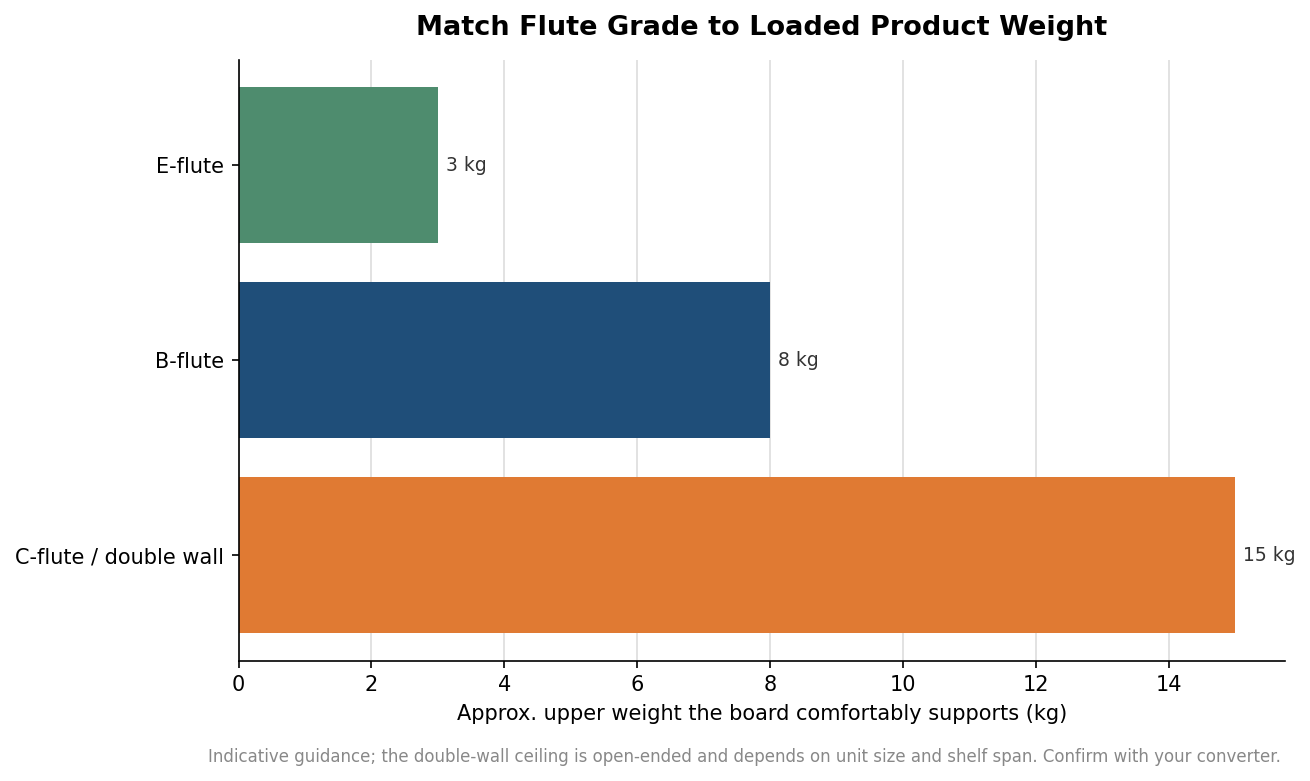
Every format above is only as good as the board under it, and board choice follows loaded weight. As a rough guide, E-flute handles light units up to roughly three kilograms and holds fine print detail, B-flute covers the middle ground of about three to eight kilograms, and C-flute or double-wall board takes the heavy end above eight kilograms where a full tray or bin of product would otherwise sag. Treat those figures as starting points rather than limits, because a wide unsupported shelf span can overload a board well before it hits the nominal weight.
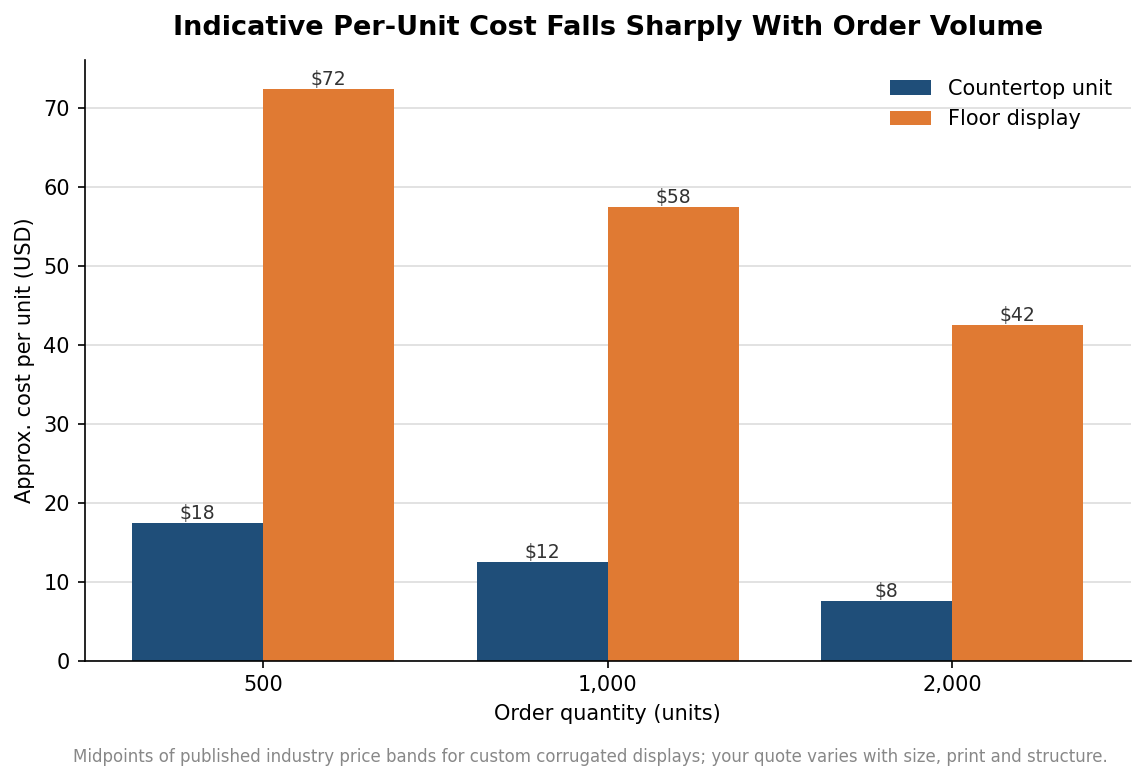
Budget scales with quantity far more than most first-time buyers expect, because the die-cutting tools, print plates and machine setup are fixed costs spread across the run. Published industry pricing for custom corrugated counter units tends to land around fifteen to twenty dollars each at five hundred pieces, falling to roughly ten to fifteen dollars at a thousand and into the five-to-ten-dollar range by two thousand. Floor displays sit far higher at every quantity because they carry more board, more structure and more assembly. Those bands are indicative, not a quote; your real number moves with size, the number of print colors and how complex the structure is to engineer and pack.
Specify the format before you specify the graphics. Decide first whether your product wants a tray’s speed, a bin’s volume, a strip’s borrowed space, a riser’s height or a holder’s messaging, then choose flute grade from the loaded weight, and only then design the print. Doing it in that order keeps you from paying for a heavy tiered unit when a flat tray would have cleared through faster, or from ordering an elegant riser for a product that a retailer will only ever give three inches of counter to hold. The format is the decision that quietly governs restocking speed, retailer approval and reorder rate, so it deserves to be made first and made deliberately.
Leave a Reply